Argentina still lacks a deepfake sex offense
Argentina has no specific criminal offense for sexual deepfakes. A Lomas de Zamora case and a bill keep the debate open.
Argentina still has no specific criminal offense for sexual deepfakes, even though Law 27,736 added digital violence to Law 26,485. In parallel, prosecutors in Lomas de Zamora are investigating a case involving AI-created sexual images that may have affected 45 students.
Update November 4, 2026: the note now adds that Law 27,736 incorporated digital violence into Law 26,485, but did not create an autonomous criminal offense for sexual deepfakes. It also includes progress in the Lomas de Zamora case, where 45 possible victims were identified, and the existence of a bill in Congress to punish the creation and distribution of this content without consent.
Argentina still has no specific criminal offense for sexual deepfakes, even though Law 27,736 added digital violence to Law 26,485. At the same time, a case in Lomas de Zamora identified 45 possible victims of AI-generated sexual images and reignited the debate over whether the current criminal framework is enough for this kind of material.
What did Chequeado say about the legal framework?
Chequeado reported that Argentina does not currently have a specific criminal offense to punish sexual deepfakes as such. That leaves a regulatory gap for a type of synthetic material that can circulate without a direct or automatic criminal classification.
The coverage also points to a recent judicial reference that expands the possible reach of an existing offense. In 2025, the Criminal Appeals and Guarantees Court of Zárate-Campana held, in the D.O.P. case, that Article 128 of the Criminal Code can cover representations of child sexual abuse generated or altered with AI.
How far does that judicial interpretation go?
The interpretation cited by Chequeado does not create a new offense, but it does open the door for Article 128 to apply to content produced or altered with artificial intelligence. The exact scope will depend on each case, but the judicial reference shows that the criminal debate has already reached synthetic material.
The available material does not detail other rulings, legislative reforms, or uniform application standards. For that reason, the picture left by the source is limited, but clear, there is no specific criminal classification for sexual deepfakes and, at the same time, there is a judicial reading that could bring some AI-generated representations under an existing rule.
What changed with Law 27,736?
Law 27,736 incorporated digital violence into Law 26,485, but did not create a standalone criminal offense for sexual deepfakes. That adds a regulatory response in the gender violence sphere, although it does not by itself resolve criminal punishment for this synthetic content.
According to the research material, that reform was cited as part of Argentina’s framework for addressing digital violence, but it did not become a specific crime for creating or distributing sexual deepfakes. The distinction matters, because recognizing digital violence is not the same as criminalizing the conduct.
What happened in Lomas de Zamora?
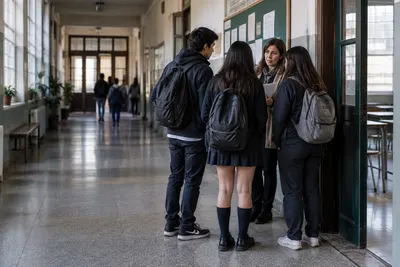
In the investigation into AI-created sexual images in Lomas de Zamora, 45 possible victims were identified, and families spoke of about 50 affected students. The case was linked to two 15-year-old students and exposed the spread of the material inside and outside the school community.
La Voz reported that the two teenagers were charged with generating and distributing fake sexual images of at least 45 female classmates at Colegio Modelo de Lomas de Zamora. According to that coverage, the material also circulated on adult websites and among students at other schools.
MDZ added that the case would involve at least 45 adolescents from first to fifth year and described the conduct under investigation as the creation, circulation within the educational community, and sale of fake intimate images.
What does the new juvenile criminal regime say?
The coverage reviewed said Law 27,801 took effect on September 5, 2026, and set out a regime applicable to adolescents from age 14 until just before they turn 18. According to that material, the law did not create a specific offense for sexual deepfakes.
That point appears in the middle of the debate over the Lomas de Zamora investigation and adds a reference on criminal responsibility age and procedural framing. It does not change the core issue in this story, which remains the lack of an autonomous criminal offense for this content.
What bill appeared in Congress?
The coverage identified Bill 3955-D-2024 as an initiative introduced in Argentina’s Congress to add to the Criminal Code a provision that would punish the creation and distribution of deepfake content without consent. That shows the issue has formally entered the legislative agenda.
The available material does not say the initiative has been approved or that it has replaced the legal gap described by Chequeado and specialized coverage. For now, it appears as a future attempt at criminalization, not a current legal solution.
What about fraud cases based on synthetic identities?
The available coverage of an alleged romance scam in Argentina does not allow the case to be confirmed or the amount to be treated as definitive. Head Topics reported that an AI-created digital identity may have convinced an 84-year-old man to invest $160,000 in a fake platform, but the source did not provide independent confirmation of the episode or the figure.
That limitation matters because the research material is not enough to present the incident as established fact. What does stand out is that, in this type of coverage, verifying both the case and the financial loss can be as sensitive as the technology used to build the synthetic identity.
What is the corporate response around AI?
EY Argentina describes audit and certification services tied to artificial intelligence. According to the firm, those services include assurance work on governance, risk, and controls for AI systems.
That data offers a corporate counterpoint to the legal landscape and the uncertainty around fraud verification. In the material provided, EY does not appear tied to a specific case, but to a service offering focused on controls and certification for AI systems.
Sources
- Notas sobre deepfakeperfil.com· Perfil
- Qué hacer si tu hija o hijo es víctima de un deepfake sexual creado con IAchequeado.com· Chequeado
- La estafa romántica con IA que vació los ahorros de un ancianous.headtopics.com· Head Topics
- Auditoría de IA con SOC, verificación y certificacióney.com· EY Argentina
- Deepfakes sexuales en Argentina: el vacío penal tras Lomasderechoartificial.com· Derecho Artificial
- Lomas de Zamora: imputaron a dos alumnos por crear imágenes sexuales con IAurgente24.com· Urgente24
- Habló la mamá de una de las víctimas de las fotos creadas con IA: “Publicaron datos reales de las chicas”lavoz.com.ar· La Voz
- Crece el negocio de los videos sexuales falsos de alumnas hechos con IAdiariopopular.com.ar· Diario Popular
- El Colegio Modelo Lomas rompió el silencio tras las denuncias por imágenes sexuales creadas con IAmdzol.com· MDZ
- ¿Pueden juzgar a adolescentes desde los 14 años por crear imágenes sexuales con IA?diariohuarpe.com· Diario Huarpe