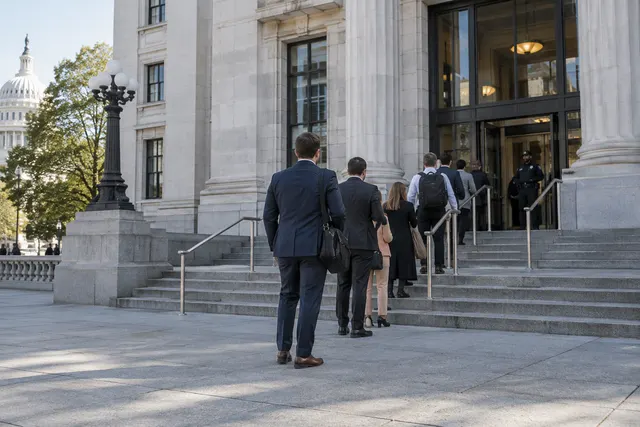
SECURE Data Act Advances in U.S. House
SECURE Data Act was filed as H.R. 8413 in the House and has seen no recorded Senate action yet.
The SECURE Data Act was introduced in the U.S. House as H.R. 8413 and referred to the Energy and Commerce and Judiciary committees, with no further Senate action recorded so far.
Update November 23, 2026: The SECURE Data Act is now identified in the legislative record as H.R. 8413 in the U.S. House of Representatives, with referrals to the Energy and Commerce and Judiciary committees. New analyses also clarify its effective date timeline, a possible tightening of parental consent for teenagers, and the fact that it does not include a private right of action.
The SECURE Data Act was introduced in the U.S. House of Representatives as H.R. 8413 and sent to the Energy and Commerce and Judiciary committees. The legislative record reviewed so far shows no subsequent Senate action. The bill corresponds to the Securing and Establishing Consumer Uniform Rights and Enforcement over Data Act.
Who would the bill cover?
Cookie-Script’s analysis says the bill would apply to organizations doing business in the United States or processing data from U.S. residents, provided they exceed certain thresholds for consumers, revenue or data sales. Those thresholds still need to be checked against the official text, so the exact scope cannot yet be considered final.
That same material presents the SECURE Data Act as a federal privacy proposal that could apply to companies operating in the U.S. market or handling data from people based there. For companies with subsidiaries or operations in Latin America, that could mean reviewing data flows, contracts and compliance programs if the final text confirms those parameters.
What effective dates are mentioned?
IAPP says the bill includes provisions that would take effect one to two years after enactment. That timeline broadly matches the structure already discussed in earlier analyses, although confirmation of the final text and any legislative path is still pending.
| Aspect | Timeline or condition | Note | Source |
|---|---|---|---|
| Legislative progress in the House | H.R. 8413 introduced and referred to Energy and Commerce and Judiciary | The reviewed record shows no subsequent Senate action | Congress.gov |
| Bill identification | Securing and Establishing Consumer Uniform Rights and Enforcement over Data Act | Full name associated with the SECURE Data Act | Congress.gov |
| Effective date for provisions | One to two years after enactment | Timeline attributed to IAPP | IAPP |
| Verifiable parental consent | Expanded to teens ages 13 to 16 | According to the bill analysis | Legal500 |
| Private right of action | Not included | According to DLA Piper’s legal analysis | DLA Piper |
What other regulatory changes does it propose?
The bill would expand the requirement for verifiable parental consent to teenagers ages 13 to 16, according to the analysis of the proposal. DLA Piper also says it does not include a private right of action, which would limit the ability of individuals to file direct lawsuits under that framework.
What objections appear on the legal side?
A Law360 analysis attributes criticism from DiCello Levitt attorneys to the SECURE Data Act, saying it would weaken enforcement, eliminate stricter state protections and favor data extraction over protection and accountability. The available reporting does not allow the full scope of those remarks to be confirmed, so they should be treated as a journalistic attribution rather than a settled conclusion.
Taken together with the lack of recorded Senate action, those concerns leave the bill in a monitoring phase for now rather than a finalized regulatory outcome. They also leave open how a uniform federal framework would interact with tougher state regimes and with the regional operations of U.S. companies in Latin America.
Sources
- SECURE Data Act Explained - Privacy lawscookie-script.com· Cookie-Script
- Democrats win Congress: what changes for AI rules, privacy and advertising?ppc.land· PPC Land
- Trials : Law360 : Legal News & Analysislaw360.com· Law360
- U.S.: Comprehensive Federal Privacy Legislation Introducedprivacymatters.dlapiper.com· DLA Piper
- All Info - H.R.8413 - 119th Congress (2025-2026): SECURE Data Actcongress.gov· Congress.govUnverified URL
- The SECURE Data Privacy Bill Is Worth Reading, Even If It Diesnews.bloomberglaw.com· Bloomberg Law
- SECURE Data Act: Analysis of the new federal privacy billiapp.org· IAPP
- Hey Rocky, Watch Me Pull a Rabbit Out of My Hat! Is This the Year the Federal Government Passes Comprehensive Privacy Legislation?securityboulevard.com· Security BoulevardUnverified URL
- Taking stock of US House Republicans' proposed SECURE Data Actiapp.org· IAPP
- The SECURE Data Act: A Federal Privacy Framework Moves Forwardlegal500.com· Legal500
- H.R.8413 - 119th Congress (2025-2026): SECURE Data Actcongress.gov· Congress.govUnverified URL