Paraguay, Guatemala, Chile revise digital laws
Paraguay, Guatemala and Chile are moving ahead on cyber and digital bills, with technical reviews, new debate steps and added urgency.
Paraguay, Guatemala and Chile are still processing bills tied to cybersecurity and digital environments, but each is moving at a different pace. In Paraguay, a public hearing ended with a technical working group. In Guatemala, initiative 6347 went back to first debate. In Chile, the executive branch gave urgent priority to a proposal centered on children.
Paraguay, Guatemala and Chile all have bills moving through their legislatures that deal with cybersecurity and digital environments, but each country is taking a different path. In Paraguay, the cybersecurity law remains under review and a public hearing ended with a decision to set up an interinstitutional technical working group. In Guatemala, initiative 6347 went back to the start of the legislative process. In Chile, the executive branch assigned urgent priority to "Safe Digital Environments," with a focus on children and adolescents.
What happened in Paraguay with the cybersecurity law?
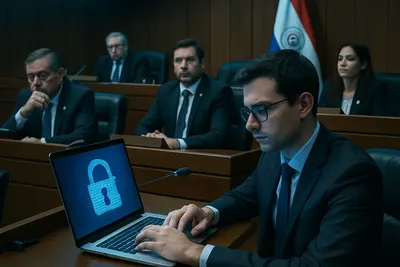
In Paraguay, the bill titled "Law on Cybersecurity of the Republic of Paraguay," Exp. D-2585561, remains under review in Congress and was discussed at a public hearing that ended without a full debate on the revised text. Several public and private institutions chose not to comment, and participants agreed to create a working group to review the changes.
ABC Color reported that the hearing was held on a modified version of the bill, which raised concerns among attendees because of the broad scope of the proposal, which covers cybersecurity, cyberintelligence, nanotechnology and artificial intelligence. The Chamber of Deputies also said the meeting ended with the decision to organize an interinstitutional technical table to coordinate changes and move toward a regulation that is "100% applicable." That group would be formalized in the following days, with date and time still to be set.
Coverage from Radio 780 AM and 1140 AM added another layer of criticism, with experts such as Miguel Ángel Gaspar calling for a deep technical review before the legislative process moves forward, especially regarding the drafting and scope of the text. La Tribuna, meanwhile, described the initiative as an attempt to gather into a single law topics as varied as critical infrastructure, tariffs, military doctrine, artificial intelligence and nanotechnology, which fed objections to its regulatory breadth.
What stage is the Guatemalan initiative at?
In Guatemala, initiative 6347 for a Cybersecurity Law is still being processed, but approval has to restart from first debate after it was sent back for new committee reports. Prensa Libre said that if the process moves ahead without setbacks, the report could be approved in September and the law could be enacted before the end of the ordinary session on November 30.
The return forces the legislative process to begin again once the committees issue new reports. According to the coverage, members of the Economy Committee see it as possible for the text to be ready around November if it clears that stage and the debate that follows.
What did Chile define for Safe Digital Environments?
In Chile, the executive branch gave urgent priority to the "Safe Digital Environments" bill, which seeks to protect children and adolescents in digital settings and is now in its first constitutional stage in the Chamber of Deputies' Future, Science and Technology Committee. The Ministry of Social Development and Family set a target of submitting amendments before August 28.
The ministry said an interministerial working group spent the previous two months on the bill, with participation from Education, Health, Justice and Human Rights, Public Security, Transport and Telecommunications, Science, Women and Gender Equity, and Digital Government. It also said the regulatory focus should not be on online content itself, but on access conditions and, at least in part, platform design.
The bill combines four earlier parliamentary motions and addresses issues such as minors' access to social networks, platform responsibility, algorithmic designs that hold children's attention, and child protection within the broader cybersecurity framework. According to the ministry, this is a cross-cutting concern among lawmakers from different political perspectives.
Sources
- Audiencia sobre “Ley de ciberseguridad” termina en otra mesa de trabajoabc.com.py· ABC Color
- Ciberseguridad: Expertos cuestionan proyecto de ley y piden una revisión técnica1140am.com.py· Radio 780 AM / 1140 AM
- La ley de Ciberseguridad y la regulación de Ironmanlatribuna.com.py· La Tribuna (Paraguay)
- Ejecutivo otorga suma urgencia a proyecto de Entornos Digitales Seguros y acelera acuerdo transversal por la infanciamidesof.gob.cl· Ministerio de Desarrollo Social y Familia de Chile
- La Ley de Ciberseguridad que todos citan y casi nadie ha leídotransformationtrends.com· Transformation Trends
- Ley de ciberseguridad podría estar lista en noviembre si supera dictamen y discusión, según comisiónprensalibre.com· Prensa Libre
- Propuesta de “Ley de Ciberseguridad” fue ampliamente analizada en audiencia públicadiputados.gov.py· Cámara de Diputados de Paraguay
- Ley de ciberseguridad: diputada destaca importancia y cuestiona falta de interés del Miticenparaguay.net· EnParaguay.net