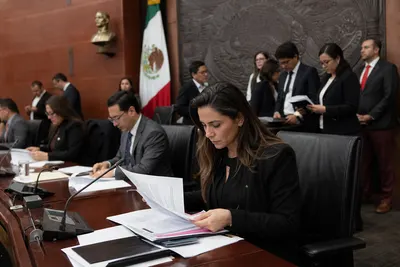
Mexican Senate reviews AI laws
Mexico’s Senate is weighing reforms on AI, digital violence and personal data, with penalties for fake intimate content and rules for minors.
Mexico’s Senate will review a bill to strengthen protections for children and adolescents online, while other committees consider criminal penalties for creating fake intimate content with artificial intelligence and a proposal to address digital violence against women.
Mexico’s Senate has a bill on its agenda to strengthen protections for children and adolescents in digital environments, while other committees are reviewing criminal reforms to punish the creation of fake intimate content with artificial intelligence. At the same time, a lawmaker has introduced a proposal to prevent digital violence against women, and the private sector is pushing an alliance with Congress to help shape AI and cybersecurity regulation.
What would change for children and adolescents?
The bill the Senate will review would require federal, state, municipal and Mexico City authorities to take steps to prevent, address and punish violence against minors in digital environments. It would also require protection of their personal data across all settings.
According to Diario Marca and Milenio, the text also adds the Interior Ministry as the authority responsible for issuing classification guidelines for radio, television, platforms, digital apps, videos, video games and printed materials distributed through physical or digital media. The proposal also requires video games and apps sold in digital stores to display their rating and, when they are suitable for minors, clearly indicate whether they include parental controls.
What is happening with artificial intelligence and intimate content?
The Senate is reviewing a proposal to amend articles 199 Octies and 199 Nonies of the Federal Penal Code and classify the generation of intimate images, videos or audio without consent as a violation of sexual privacy when it is produced with artificial intelligence or other digital tools.
Coverage from Vanguardia, Ground News, AM and Reporte Águila agrees that the bill is part of an effort to protect privacy against technologies that make it possible to create and spread sexual material without authorization. AM reported that the proposed penalties range from 4 to 8 years in prison and fines of 400 to 1,000 UMA for anyone who generates, simulates or edits this type of content with AI or digital editing software, with the same punishment applying to its distribution.
The proposal also includes specific penalties for material that realistically or plausibly depicts children, adolescents or people unable to understand or resist, in sexual acts or bodily display for sexual purposes, whether or not there is an identifiable real victim.
What other initiative was introduced in the Chamber of Deputies?
Federal lawmaker Ana González González introduced a bill to reform the General Law on Women’s Access to a Life Free of Violence and prevent digital violence against women.
According to Diario 7 Noticias, the proposal would rely on permanent prevention campaigns, digital literacy and personal data protection. That legislative effort adds to the package of reforms Congress and the Senate are discussing on digital violence, privacy and the use of artificial intelligence.
How is the private sector entering this agenda?
The CCE and Mexico’s Congress are promoting the National Digital Alliance as a permanent dialogue mechanism to contribute technical input and international experience to regulatory design in artificial intelligence, digital finance, cybersecurity, data protection, connectivity, digital infrastructure, tech talent and e-commerce.
Pulso SLP, Tecnoempresa and Safra Report describe the alliance as a structured agenda built around six work areas and coordinated between a digital caucus of lawmakers from different parties and the CCE’s High Technology Committee. One stated goal is to position Mexico as a hub for innovation, investment and talent, with AI and cybersecurity regulation a priority to attract investment and innovation.
Sources
- Revisará el Senado de la República la minuta que busca garantizar entornos digitales seguros para menoresdiariomarca.com.mx· Diario Marca
- OPINIÓN | Las niñas y los niños no son un mercadonacion321.com· Nación321
- Impulsa iniciativa para prevenir la violencia digital contra mujeresdiario7noticias.com.mx· Diario 7 Noticias
- Senado analiza tipificar como delito el uso de imágenes íntimas con IAvanguardia.com.mx· Vanguardia
- CCE y Congreso buscan mejorar regulación de inteligencia artificialpulsoslp.com.mx· Pulso SLP
- Senado analiza dar hasta 8 años de cárcel por crear contenido íntimo falso con IAam.com.mx· AM
- SENADO BLINDA INTIMIDAD: IA NO PODRÁ CREAR VIDEOS ÍNTIMOS SIN CONSENTIMIENTOreporteaguila.mx· Reporte Águila
- Senado revisará minuta sobre derechos digitales para menoresmilenio.com· Milenio
- CCE y Congreso buscan mejorar regulación de inteligencia artificialpulsoslp.com.mx· Pulso SLP
- CCE y Congreso lanzan Alianza Nacional Digital; buscan mejorar regulación de inteligencia artificial y ciberseguridadsafrareport.com· Safra Report
- Senate Will Prioritize Law to Punish Generation of Intimate Content with AIground.news· Ground News
- Apoyando a la bancada digital; por Hugo González en El Universaltecnoempresa.mx· Tecnoempresa / El Universal