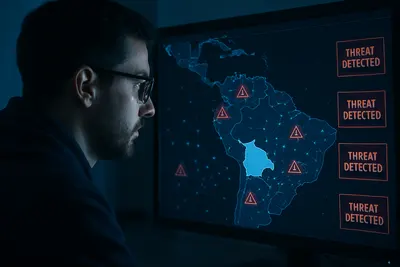
48% of Latin American SMBs See Cloud Breaches as Their
Infobae reported that nearly half of small and medium-sized businesses in Latin America identify cloud security breaches as their main threat. Kaspersky
Infobae reported that cloud security breaches happen when information stored in digital services is exposed, and that 48% of Latin American SMBs see them as their biggest risk. The concern comes as Kaspersky continues to push basic steps such as updating apps and software, enabling automatic backups, and reviewing old accounts and passwords, while Semana said Colombia logged 10.9 trillion cyberattack attempts and pointed to insecure cloud configurations as part of the regional threat picture.
A growing risk for SMBs
Infobae published a report saying cloud security breaches occur when information stored in digital services is exposed. In that same story, it said 48% of Latin American SMBs view those breaches as their biggest risk.
The finding highlights a concern that is already taking hold among smaller businesses, where exposure of data stored in digital environments is seen as one of the most sensitive threats.
Digital hygiene recommendations
At the same time, Kaspersky issued a statement on digital hygiene habits in Latin America. It recommended keeping applications and software updated, making automatic backups, and reviewing old accounts and passwords.
The company tied those practices to the need to reduce exposure in everyday use of services and credentials. The message centers on basic steps, but also on routines that are often postponed in both corporate and personal settings.
Colombia and the regional picture
A separate report by Semana said Colombia recorded 10.9 trillion cyberattack attempts. The piece also cited insecure cloud configurations as part of the broader risk environment.
That figure adds to a regional reading in which the problem does not appear in isolation. On one side, companies identify the cloud as their main source of exposure. On the other, warnings remain about configuration and administration practices that can expand the attack surface.
Sources
- Cómo la filtraciones de datos puede acabar con una empresa: el temor del que todos deben protegerseinfobae.com· Infobae
- Colombia registró 10,9 billones de intentos de ciberataques y concentra el 8 % de los incidentes de América Latinasemana.com· Semana
- El 79% de los latinoamericanos borra su historial de navegación, pero solo el 36% cambia sus contraseñas regularmentelatam.kaspersky.com· Kaspersky